April 2026 – In the coal mining industry, the risk of self-heating in stockpiles is not just a technical issue, but also a safety and operational sustainability issue. Coal stored in large volumes can undergo natural oxidation. If not properly monitored, this process has the potential to slowly increase temperatures beyond safe limits and trigger a fire risk, especially prior to distribution by barge.
The permissible temperature threshold in many operational procedures is below 50°C. Exceeding this limit not only increases the potential for incidents but also risks logistical disruptions, quality claims, and even financial losses. Therefore, a technology-based monitoring approach is becoming increasingly relevant.
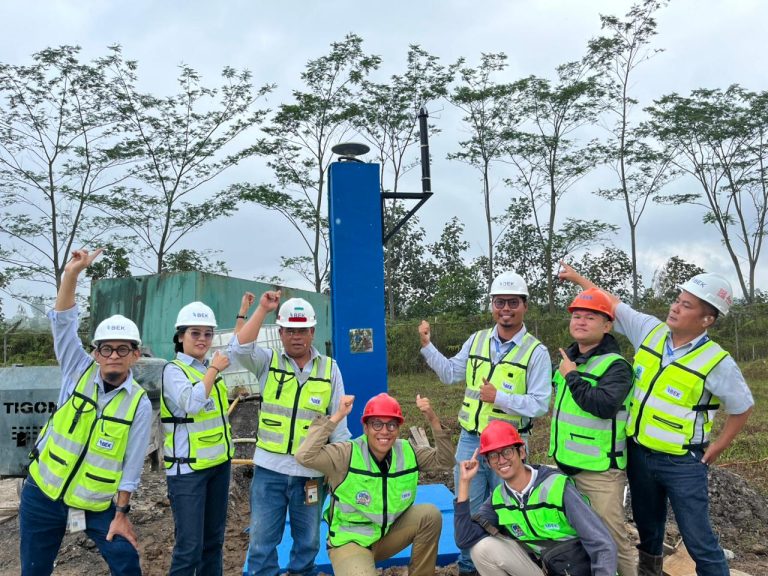
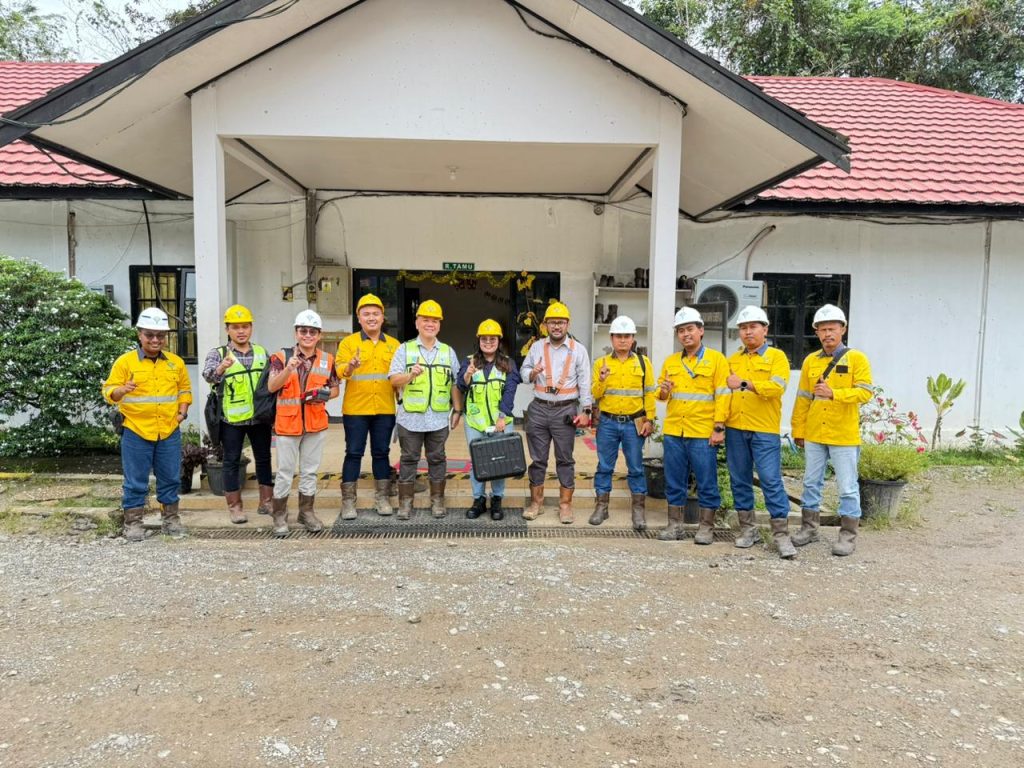
On April 1–4, 2026, an on-site Proof of Concept (POC) was conducted using a thermal drone system to comprehensively map and analyze the surface temperature of a coal stockpile. The platform used was the DJI Matrice 4T, supported by data processing via DJI Thermal and DJI Terra.
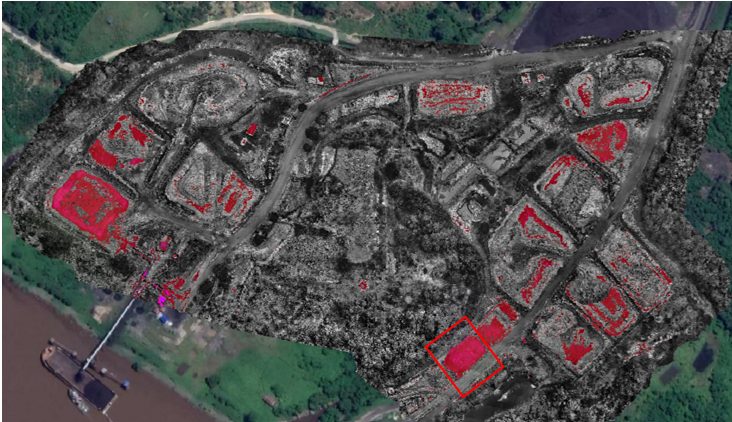
Despite rain on the first day of the mission, the data acquisition process still proceeded smoothly. Weather conditions pose a challenge to drone operations, particularly in maintaining flight stability and thermal data quality. However, with proper mission planning—from altitude settings, image overlap, to sensor calibration—data can still be consistently acquired and further analyzed.
The thermal imaging approach allows for visual and quantitative identification of temperature variations. Unlike manual measurements using a thermogun, which are point-by-point, thermal drones can map large areas in a relatively short time, producing a more comprehensive picture of heat distribution. This is particularly important in stockpiles, as hotspots are often invisible from the surface and unevenly distributed.
Initial mapping results identified several points and areas with temperatures ranging between 40°C and 60°C. Areas approaching and exceeding 50°C were of particular concern as they were above the recommended safety limits prior to distribution. The thermal data processed in DJI Terra was then analyzed to determine the precise locations of hotspots, including an estimate of the extent of the impacted area.
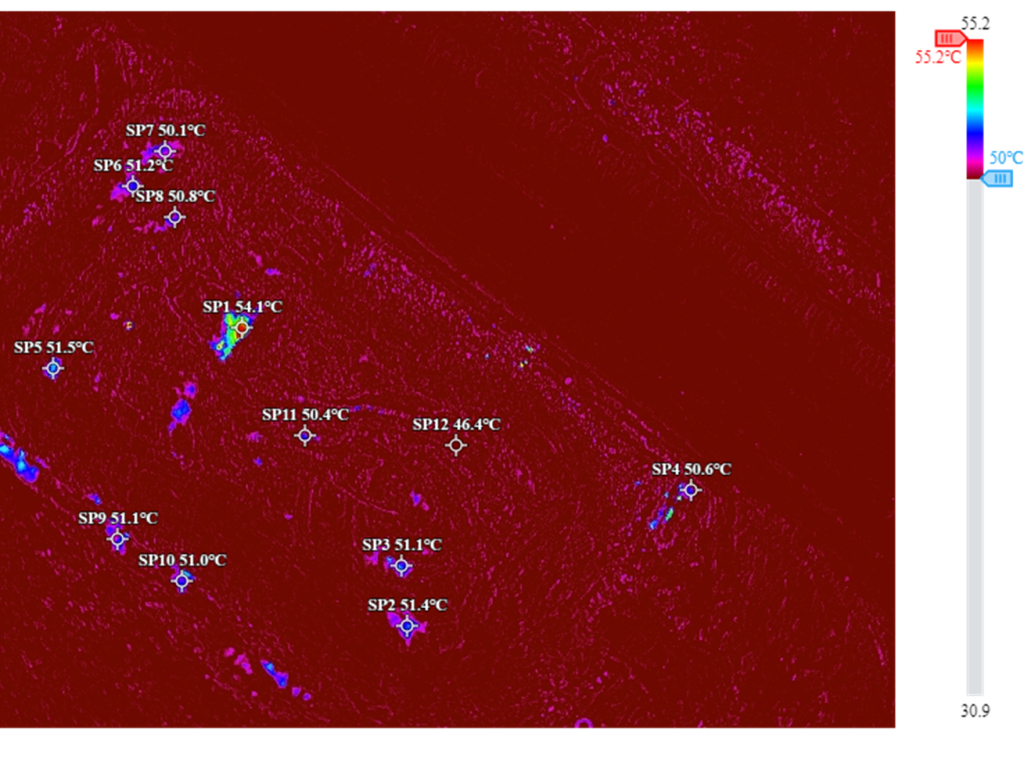
The key insight from this POC wasn't just identifying hot spots, but also demonstrating how spatial data can support rapid and targeted preventive action. Based on these findings, the operational team conducted treatment using a special fluid to lower the temperature in the identified areas.
Some time after the treatment, data collection was repeated using the same procedure to ensure consistency of readings. The results showed a significant decrease in temperature, with the entire area returning to the safe range of below 50°C. This data-driven validation demonstrates that the thermal monitoring approach serves not only as a detection tool but also as an instrument for evaluating the effectiveness of corrective actions.
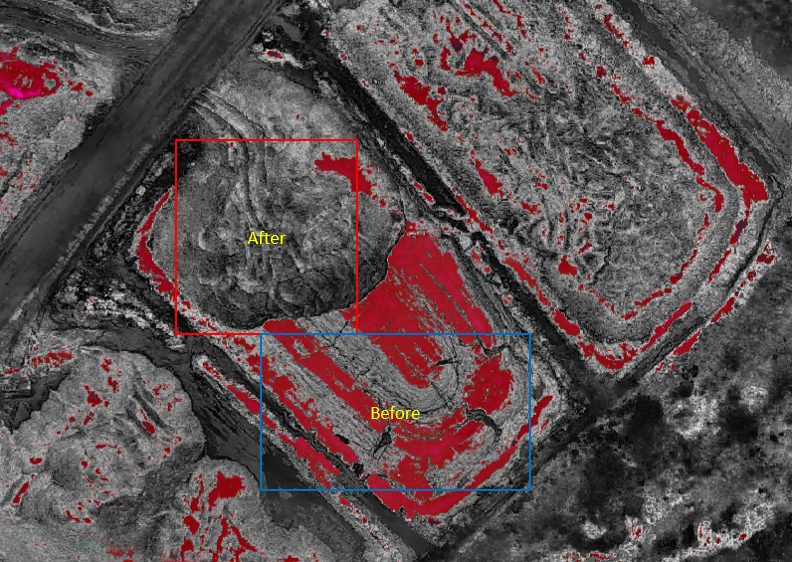
From a risk management perspective, this approach represents a shift from a reactive to a preventative system. Rather than waiting for visual indications such as smoke or a burning odor, a thermal monitoring system enables early identification before conditions escalate into incidents. In the context of barge distribution, this preventative measure is crucial because the risk of fire on board can have a far greater impact, both on safety and operational aspects.
Furthermore, the use of thermal drones offers significant efficiency. Large stockpile areas with uneven contours often make manual inspections difficult. With drones, the monitoring process can be carried out faster, safer, and without the need for personnel to be stationed in high-risk areas. The resulting data is also well-documented and can be used as a historical archive for analyzing temperature trends over time.
This POC demonstrates that the integration of thermal hardware and spatial processing software is not just a technological solution, but part of a more robust risk management strategy in the mining industry. When data informs decision-making, actions are more precise, measurable, and accountable.
In the long term, thermal drone-based stockpile temperature monitoring has the potential to become a new standard in coal mining operations. With scheduled monitoring frequency and systematic documentation, companies can build stronger early warning systems, maintain material quality, and ensure safe distribution.
Ultimately, technology is not just a tool, but an enabler for safer, more efficient, and data-driven operations. And in the context of coal stockpile management, the ability to detect and address hotspots before they exceed critical limits is a real investment in operational safety and sustainability.
Author Kholis Muhsin Lubis